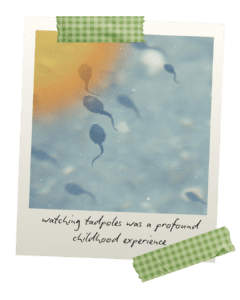
One of my amazing childhood memories is of sitting on a rock at the edge of a pool watching hundreds of tadpoles squiggling and flashing in the spring sunlight. The pool was in the middle of a marsh, and every spring rainwater would fill that pool for the frogs. The marsh was on undeveloped land at the end of my road, and it was a place I loved to play. We moved away after I finished high school, but I heard from a friend that shortly after we left the marsh was bulldozed for new houses. I was surprised at how sad I felt because there would be no more tadpoles there.
 It was, unfortunately, one of many times I struggled with being a normal human in today’s world. I often felt I was the only one who noticed, or cared, that we kept taking space away from the other animals and how magical those places were when they were still allowed to be wild. Then I discovered Deep Ecology and found out I wasn’t alone. The philosophy of Deep Ecology resonated with me so much I dedicated most of my grad school research (so far) to learning more about it.
So, what is Deep Ecology?
Arne Naess, a Norwegian philosopher, was the first to come up with Deep Ecology. Naess based Deep Ecology on the science of ecology, which studies the relationships between beings and between beings and their environment, but broadened it to address human ethics and values and how those impact our relationships with the rest of nature. For example, Naess rejected the idea that humans were one thing and nature was something else, typical in Western thinking, in favor of the belief that all life is part of the biosphere and cannot be separated.
Deep Ecology excited me because I had become frustrated with decade after decade of hearing conservationists say that the only way to convince anyone to protect a species or a piece of land was to show them the science. Since we were still bulldozing frog ponds, that clearly didn’t work. Few people were willing to sacrifice convenience or luxury in favor of saving a species or habitat that provides no direct human benefits. But that’s economics. Experiencing the magic of interacting with other forms of life is a benefit too often ignored.
Naess’s friend, Stephan Harding, in his book, Animate Earth, offered a framework that helped me understand Deep Ecology as both a philosophy and a practice. It starts with deep experience, like the one I had when I watched the tadpoles. That experience leads to deep questioning: “Why don’t people care that they are killing the frogs?” Then there’s a deep commitment such as dedicating my ministry to bringing awareness to the plight of more-than-humans. And on to the next deep experience.
Shamanic Reiki for All Beings
When I created Shamanic Reiki for All Beings, I wove some of what I had discovered about Deep Ecology into the practices of shamanism and Reiki. The combination makes my offerings a little niche, but if you read about the tadpoles and thought of a time when you experienced magic in the natural world, please join me in this work.