
There’s a story that floats around online about a trapper who became a wildlife defender because of two baby beavers. Curious whether it was true, I went looking and found an old essay about Grey Owl (whose real name was Archibald Belaney), a conservation writer and naturalist from the early 1900s who became well known for pushing people to protect beavers. His change of heart began after he killed a mother beaver and then ended up raising her orphaned kits. That experience pulled him out of trapping and onto a completely different path—one focused on caring for wildlife instead of killing.
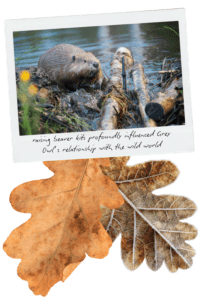 Grey Owl went on to help save beavers from disappearing in some places. He wrote about a wilderness where humans and more-than-human beings all belonged. One thing he was struck by while raising the beaver kits was how their sounds felt surprisingly human. His story began with a moment of close, tender contact with vulnerable beings and influenced how people thought about wildlife.
That story resonated deeply with me, because I’ve had a similar experience.
I’m a licensed wildlife rehabilitator in New York. I mostly work with turtles injured by cars, but my first patients were three orphaned juvenile grey squirrels. The first time one fell asleep against my chest, something in me shifted. I became a defender of squirrels, the way Grey Owl became a defender of beavers. Over time, I started to understand their chirps, growls, and whines—and the more I understood, the more I respected their squirrel-ness. Even my gardening style changed. I stopped trying to control every wild thing in my yard and started thinking about how to make better habitat.
Maybe you’ve had an encounter with a wild being that shifted how you feel about the natural world. I believe these moments impact us spiritually. They create the “why” of wildlife protection we need.