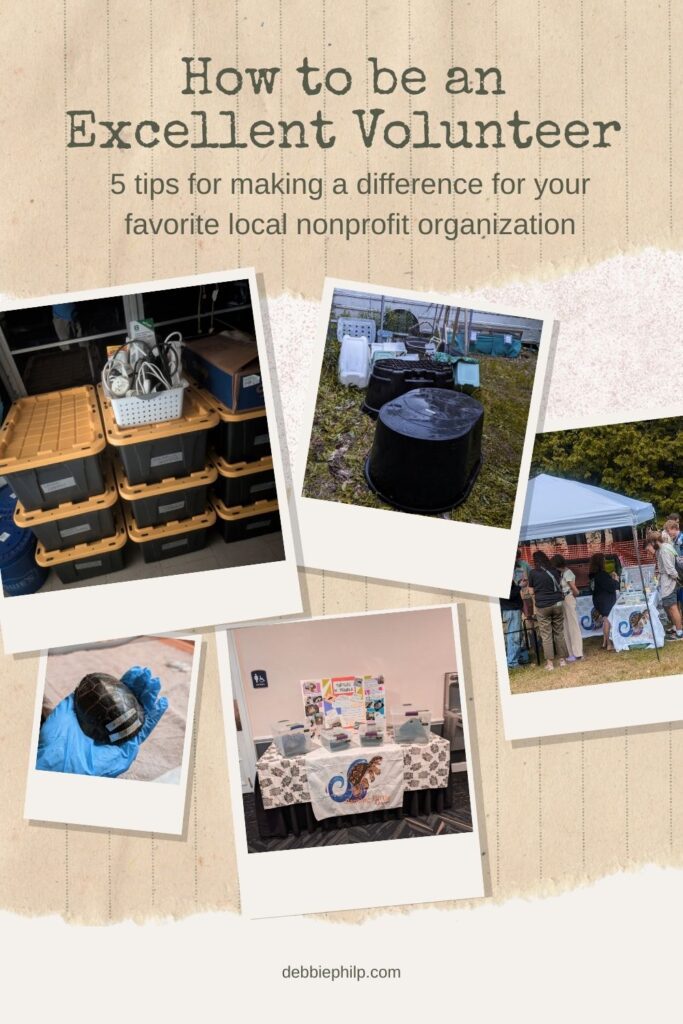
You’ve been thinking about volunteering for your favorite local nonprofit, and that’s awesome. Most nonprofit organizations rely on volunteers for both the day-to-day work and to coordinate and staff events. Many, like mine, have no employees and everyone involved is volunteering their time.
I’ll let you in on a secret, though. Most of us, especially small nonprofits, struggle to recruit and keep excellent vo lunteers.
Finding, training, and engaging volunteers takes time and other resources that we just don’t have. We want you to feel satisfied and appreciated, and have fun but, honestly, when I’m neck deep in dirty turtle tubs, I need a helper who’s willing to get their hands dirty now and have fun later.
Our failure to do a good job of asking doesn’t mean you shouldn’t volunteer. If you do these five things before and while you’re volunteering, you can be an excellent volunteer. And you will be appreciated even more for making the effort.
Find out how you can help.#
Nonprofits often list opportunities for volunteering on their websites and in social media posts, so check those first. If the organization has an email newsletter, sign up for the list, because that is another way they may announce their volunteer needs. If those fail, reach out by website contact, email, social media message. You’ll get a more decisive reply if your message includes where you live, how much time you have available, and any special skills or resources you have.
Share your best skills.#
You might be surprised to learn that you can help a nonprofit in amazing ways with skills you already possess. What area are you an expert in? What did you or do you do for work? Like any business, much goes on behind the scenes to keep a nonprofit running. You might be surprised how the things you are great at already apply to volunteering.
Are you a great recordkeeper? You might help with inventorying supplies or keeping track of everyone’s volunteer hours. Good photographer? Offer to snap pictures for the annual report. Good at writing marketing copy? Offer to craft social media posts or fundraising appeals. Have some management skills? Ask about joining the board of directors. Give it some thought and you will come up with many ways you can help without much training.
You can also use volunteering to build your skill set but consider what learning you can do on your own. For instance, I’m currently expanding my wildlife rehabilitation skill set to include treating wildlife caught in oil spills. To be allowed into a spill site, I need to complete certain hazardous materials trainings, which I am doing on my own. Want to add fundraising to your resume? Read a book or take a course before or while you are volunteering and put what you learn to work.
Speaking of learning, volunteering is a great way for college students to get some work experience on their resumes. Consider which volunteer opportunities are a good fit for your major. You might even be able to arrange an internship, but be prepared for it to be unpaid unless you go to a large nonprofit.
Make a commitment and show up.#
One of the hardest things I have done was to get real about the time I had to volunteer and not take on anything that required more than that. When you’re passionate about something, you want to throw yourself into it, but overcommitting doesn’t help you or the nonprofit. It’s okay if you can only give an hour a week or one Saturday morning a month. Be upfront about your time limitations. I’d much rather train a volunteer to help me for two hours every other week and know I can count on them to show up consistently, than have an enthusiastic helper show up every day for three weeks and then ghost me when they realize they aren’t getting anything done at home.
Unless you really like driving and have time for a longer commute, choose a nonprofit close to your home or work. You will be more likely to continue if it’s easy to pop by and help for an hour than if you have to include a couple of hours of commute time in your commitment. There may also be administrative things you can do from home, like stuffing envelopes or updating a spreadsheet. Whatever you commit to, stick with it. And if life changes and you can’t make it one day or can’t continue, let the nonprofit know you won’t be there when expected. Believe me, we have all needed to step away from things and we will appreciate any help you give.
Become a fundraiser.#
You don’t have to be a professional fundraiser to help your local nonprofit raise money. Share their donation page with your social media followers. Set up a Facebook fundraiser for the nonprofit using the tools available on their page. Forward emails from the organization with the donation link. And don’t forget to check with your employer about their charitable giving and donation matching programs.
Learn about the nonprofit’s cause and advocate for it.#
One of the biggest challenges a nonprofit faces is how to spread the word about their work. Read the organization’s mission and vision statements. Research (or ask) why the mission is important, who they help, and the “whys” behind their vision. For me, an excellent volunteer shows up to scrub dirty turtle tanks, but also tells everyone they know how to help turtles before they get hit and stands up at their town board meetings in defense of wetland preservation. Help your favorite local nonprofit fulfill their mission and you will be an excellent volunteer.