
Creating wildlife habitat in your backyard requires balancing the needs of both humans and more-than-human species. Thoughtful design can make rewilded spaces inviting, functional, and beautiful while still supporting biodiversity. There are definitely challenges to rewilding, but let’s look at a few big-picture design considerations to give you a place to start thinking about your own rewilding project.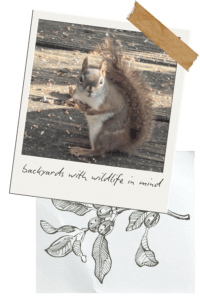
- Think balance. Balance the needs of wildlife and humans by providing hiding places and escape routes for animals, and spaces for human activity like seating and play areas.
- Beauty matters. Native wildflowers can be both colorful and ecologically valuable. Even small meadows support birds, pollinators, and soil organisms. Sensory elements like fragrant flowers can make rewilded spaces more inviting.
- Give humans a way into the space. Gardens should be accessible so they can be used and maintained. Visibility through windows allows interaction even when staying indoors.
Rewilding is possible with careful planning, but challenges exist. In addition to doing this work in a society that is overwhelmingly separate from nature, there are costs, insufficient information about ecosystem restoration available to the general public, and potential for conflicts whenever you invite wildlife into human-dominated spaces. I hope that this little bit of information gives you ideas about how to overcome these barriers. And remember that the Shamanic Circle for All Beings is a community full of people doing this kind of work, where we practice mutual support.
Despite challenges, small‑scale rewilding remains a powerful and accessible way to support biodiversity and well‑being for all beings.