
When you hear the word “rewilding,” you probably think of large rural estates or ambitious conservation projects far removed from everyday life. It’s easy to assume that meaningful participation in rewilding requires land, money, or special access. I believe that rewilding is possible—and valuable—even on less than an acre, right where most people live.
Rewilding often brings to mind large rural projects, like the well‑known restoration of Knepp Castle Estate in the UK that Isabella Tree describes in her 2019 book, Wilding. Those efforts are impressive—but they can also make rewilding feel out of reach for people without land, money, or resources, like me.
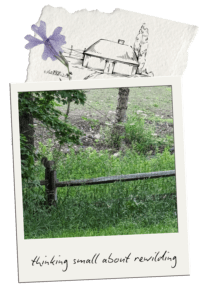 And that really bothered me. So, I researched it and found out that rewilding work is something that I can do. You can, too.
Most people in the United States live in urban or suburban areas, where contact with nature often happens in backyards, gardens, or nearby parks. When we frame conservation as something that only happens “out there,” we miss opportunities to support biodiversity and to experience the mental, physical, and even spiritual benefits that come from being in relationship with the land where we actually live.
Rewilding, in an ecological sense, means restoring native plants and wildlife habitat to land that has been altered in ways that removed or reduced the species that once inhabited it. It doesn’t mean creating wilderness without people. Instead, it means creating spaces where humans and other species can coexist.
My research focused on small‑scale rewilding in private urban and suburban backyards, typically under an acre. Even though I live in a rural area, I have less than an acre to work with, too, so it seemed like a good place to start. If you don’t have a backyard, that’s okay. Other spaces like balconies, rooftops, and public parks have potential too. I’ll try to share some of that at another time, but I’m going to be concentrating on backyards in my next few posts.
My goal is simple: to show that people like us with limited space and resources can still contribute to saving the magic of biodiversity, and also reconnect with the living systems that support all of us.